Muay Thai vs Treadmill: Which Burns More Calories
Muay Thai vs Treadmill:
Which Burns More Calories

When comparing caloric expenditure, Muay Thai training burns significantly more total calories and stimulates greater metabolic demand than steady-state treadmill cardio. While a standard 45-minute treadmill jog isolates repetitive, single-plane movement, an authentic Muay Thai session combines multi-planar striking, continuous footwork, and isometric resistance against heavy bags and Thai pads.
At The Camp Martial Arts Training Center in Pompano Beach, our striking programs are structured under a coaching framework with over 20 years of combat sports experience. By alternating between anaerobic bursts and active recovery, training the "Art of Eight Limbs" forces neuromuscular adaptations and post-workout caloric burn that a stationary machine cannot replicate.
Key Takeaways
Higher Caloric Density: Muay Thai burns between 600 to 1,000 calories per hour, compared to 350 to 550 calories during a typical moderate-intensity steady-state (MISS) treadmill run.
The EPOC "Afterburn" Effect: High-intensity combat intervals trigger Excess Post-Exercise Oxygen Consumption (EPOC), elevating resting metabolic rate for up to 14 to 24 hours post-workout.
Multi-Planar Muscle Recruitment: Striking recruits the entire kinetic chain—hips, obliques, posterior chain, and shoulders—rather than isolating the lower body in the sagittal plane.
Cognitive Engagement Eliminates Plateaus: The tactical demands of timing, distance management, and combination striking eliminate the mental fatigue and rapid physiological plateaus common to machine cardio.
Physiological Comparison: Mat Conditioning vs. Machine Cardio
The table below contrasts the metabolic and biomechanical differences between 60 minutes of structured striking training and 60 minutes of steady-state treadmill running:
Metric / Physiological Factor | Authentic Muay Thai Training | Steady-State Treadmill Running (6 mph) |
Average Hourly Calorie Burn | 600 – 1,000 kcal (Weight & intensity dependent) | 400 – 550 kcal (Weight dependent) |
Metabolic Equivalent of Task (MET) | 10.5 – 12.0 METs (Vigorous combat drilling) | 7.0 – 9.8 METs (Standard moderate pace) |
Primary Energy Systems | Dual: Anaerobic glycolytic + Aerobic oxidative | Single: Predominantly Aerobic oxidative |
EPOC (Afterburn Potential) | High: Elevated oxygen debt keeps burning fat post-workout | Low to Negligible: Calorie burn ceases shortly after stopping |
Planes of Motion | Multi-Planar: Transverse (rotational), frontal, sagittal | Uni-Planar: Sagittal plane only (forward linear stride) |
Neuromuscular Demand | Reaction speed, balance, spatial awareness, core torque | Linear cadence, minimal upper-body recruitment |
Why the Treadmill Leads to Rapid Metabolic Plateaus
The human body is an efficiency machine designed for survival. When you log miles on a treadmill at a fixed incline and pace, the nervous system quickly optimizes that specific movement pattern. Within weeks, the body consumes fewer calories and recruits fewer muscle fibers to perform the exact same mile.
This creates a distinct cardio plateau:
Kinetic Adaptation: Your stride becomes biomechanically efficient, burning less energy per minute over time.
Lean Tissue Catabolism: Excessive steady-state cardio without rotational or impact resistance can lead to muscle loss, which lowers baseline resting metabolic rate.
Mental Attrition: Repetitive motion without skill progression drains dopamine and focus, leading to skipped workouts and diminished effort.
On the mats, efficiency is actively disrupted. Every round requires sudden directional changes, explosive hip snaps, and split-second defenses. Because no two striking exchanges are identical, the body cannot fall into an energy-conserving groove.
The Science of the Strike: Kinetic Chains and Rotational Core Strength
A treadmill stride moves exclusively in the sagittal plane (forward and back), engaging primarily the quads, hamstrings, and calves.
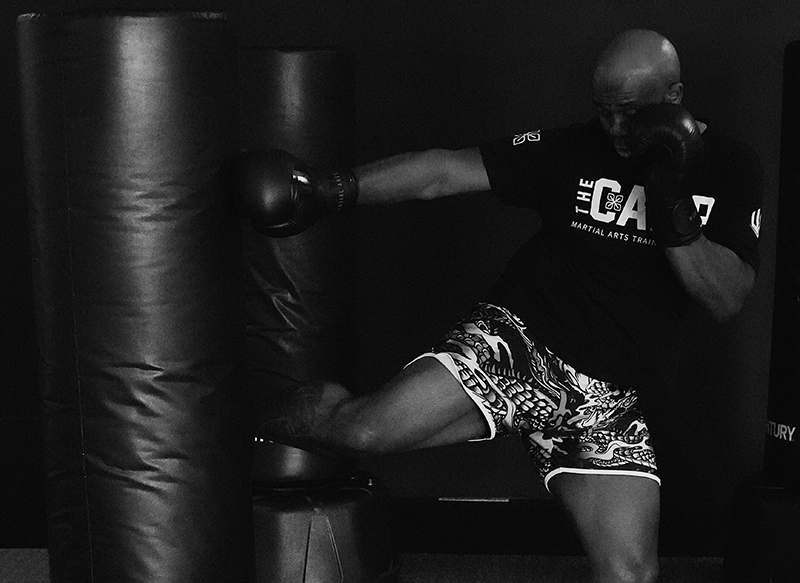
Muay Thai operates heavily in the transverse plane (rotational movement). Every strike generates force through the ground, travels up through ankle dorsiflexion and knee extension, rotates through the hips, and stabilizes across the core before delivering impact:
The Roundhouse Kick: Requires full pivot on the ball of the standing foot, generating massive torque through the obliques, glutes, and lumbar stabilizers.
The Cross & Hook: Transfers power along the kinetic chain from the rear foot through the transverse abdominis and latissimus dorsi.
Knees & Clinch Control: Demands continuous isometric contraction of the neck, lats, and deep abdominal wall while exploding upward through the hip flexors.
This constant rotational torque builds functional core strength that crunches or machine rotations cannot achieve, dramatically increasing muscular energy demand throughout the entire workout.
The 3-Minute Round: Why Interval Energy Demands Melt Fat
Muay Thai conditioning mirrors the gold standard of fat loss: High-Intensity Interval Training (HIIT) layered over an aerobic base.
At The Camp MATC, classes replicate authentic fight intervals:
Work Period (3 Minutes): High-intensity pad work, heavy bag combinations, and footwork drills spike heart rates into Zone 4 and Zone 5 (80–90%+ max heart rate), draining muscular glycogen stores.
Active Recovery (60 Seconds): Brief resets challenge cardiovascular efficiency by training heart rate recovery under controlled breathing before the next round begins.
This cycle triggers significant Excess Post-Exercise Oxygen Consumption (EPOC). To restore cellular oxygen levels, process lactic acid, and repair muscle tissue, your metabolism remains elevated for hours after you untie your gloves and leave the facility.
What a Real Class Looks Like at The Camp MATC
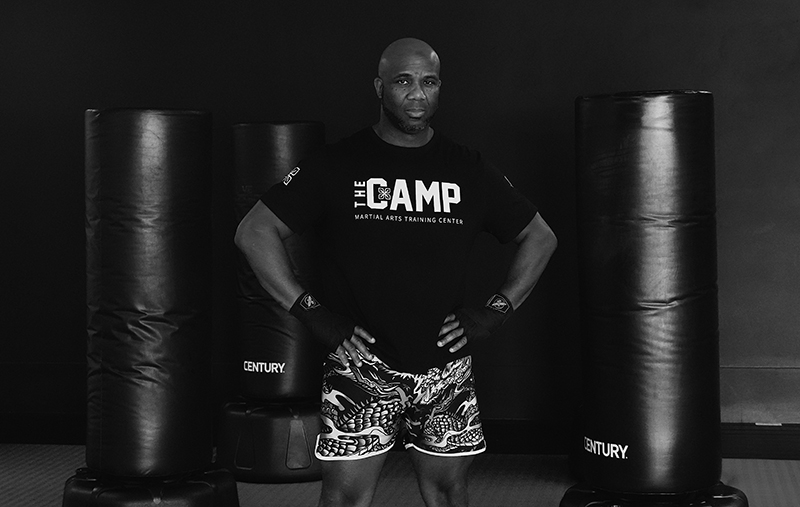
A technique-driven session at our Pompano Beach academy focuses on usable capability rather than mindless choreography:
Joint Mobility & Dynamic Warmup: Activating ankles, hips, and thoracic spine for full rotational freedom.
Technical Striking Fundamentals: Coach-led instruction covering distance management, guard mechanics, and clean footwork.
Heavy Bag & Pad Rounds: Controlled power delivery where coaches correct stance, hip turnover, and breathing.
Functional Finisher: Bodyweight and core conditioning designed around fighter-specific stamina.
Whether your goal is dropping stubborn weight, sharpening your focus, or acquiring practical self-defense skills, our room provides a supportive, ego-free community where every member works at their individual pace.
To understand why martial arts conditioning surpasses machine cardio, look at how a session is programmed at The Camp MATC. Rather than locking into a steady heart rate, the body cycles through distinct physiological demands across a 60-minute class:
00:00 – 10:00 (Dynamic Activation & Kinetic Prep): Joint circles, thoracic spine mobility, jump rope intervals, and shadowboxing. Heart rate ramps to 120–135 BPM (Zone 2), priming synovial fluid and neuromuscular pathways. *
10:00 – 25:00 (Skill Mechanics & Combination Drilling): Technical breakdown of footwork, hip pivots, and defensive counters with a partner. Demands high neural focus and steady aerobic baseline work. *
25:00 – 45:00 (High-Intensity Thai Pad & Heavy Bag Rounds): Five 3-minute rounds with 60 seconds of active recovery. Heart rates peak between 165–185 BPM (Zone 4/5). Each round demands maximum anaerobic power during combination bursts, forcing rapid lactate clearance during the 1-minute reset. *
45:00 – 55:00 (Fighter Conditioning & Core Finisher): Rotational medicine ball throws, clinch pummeling isometric holds, and explosive bodyweight movements targeting the deep abdominal wall and posterior chain. *
55:00 – 60:00 (Down-Regulation & Static Decompression): Diaphragmatic breathing and targeted hip/hamstring stretches to shift the central nervous system out of sympathetic fight-or-flight into parasympathetic recovery.
This precise structural wave is what elevates Excess Post-Exercise Oxygen Consumption (EPOC) far beyond the flat metabolic curve of a 45-minute jog.
Real-World Case: Comparing Caloric Output on a 180-Pound Individual
Treadmill (6.0 mph for 60 Minutes):
Estimated Active Calories: ~480 kcal Metabolic Demand: Steady-state aerobic expenditure Caloric Burn 2 Hours Post-Workout: ~0 kcal (EPOC returns to baseline within 30–45 minutes) Muscle Fiber Activation: Primarily Type I (slow-twitch endurance fibers in calves, quads, and hamstrings)
Muay Thai Striking (60 Minutes at The Camp MATC):
Estimated Active Calories: ~780 – 920 kcal Metabolic Demand: Mixed anaerobic glycolytic + aerobic oxidative Caloric Burn 2 Hours Post-Workout: ~75 – 120 additional kcal via sustained oxygen debt (EPOC) Muscle Fiber Activation: Both Type I and explosive Type II (fast-twitch fibers recruited during heavy roundhouse kicks, knees, and rotational hooks)
Joint Longevity: Rotational Impact vs. Repetitive Impact Loading
Beyond raw calorie burning, joint preservation plays a massive role in long-term fat loss consistency. A 45-minute treadmill run subjects the lower body to approximately 5,000 to 6,000 foot strikes, each delivering ground reaction forces of 2.5 to 3 times your body weight directly up through the ankles, knees, and lumbar spine in a rigid, repetitive motion. For individuals carrying excess weight, this repetitive stress often manifests as shin splints, runner’s knee, or plantar fasciitis. In contrast, striking mechanics disperse kinetic energy into an external target (a dense foam Thai pad or shock-absorbing heavy bag) wearing properly fitted hand wraps and 16-ounce gloves. Movement shifts dynamically across rotational, lateral, and linear planes, spreading stress across multiple muscle groups rather than subjecting the same joints to identical repetitive trauma. You achieve peak cardiovascular output without wearing down your joints.
Frequently Asked Questions
Does Muay Thai burn more calories than running on a treadmill?
Yes. Muay Thai burns an estimated 600 to 1,000 calories per hour by engaging the entire body against physical resistance (bags and pads) in multi-directional movement patterns, compared to the 400 to 550 calories typically burned during a steady-state run.
Can beginners do Muay Thai for fitness without prior combat experience?
Absolutely. Real martial arts conditioning is scalable to any fitness level. Beginners focus on balance, basic stance, and fundamental combinations at their own pace without the pressure of live sparring.
Why is rotational striking better for fat loss than machine cardio?
Striking recruits the core, hips, back, and shoulders simultaneously through the transverse rotational plane. By demanding coordinated power across multiple major muscle groups, striking creates higher total metabolic expenditure than linear cardio machines.
Leave the Cardio Plateau Behind in Pompano Beach
Trading repetitive treadmill mileage for functional striking will challenge your body, sharpen your mind, and unlock conditioning you can actually use.
Ready to feel the difference on the mats? Schedule your complimentary introductory session with our team today.
Academy: The Camp Martial Arts Training Center
Address: 1616 S Cypress Road, Pompano Beach, FL 33060
Phone: (954) 852-5369
Website: www.TheCampMATC.com